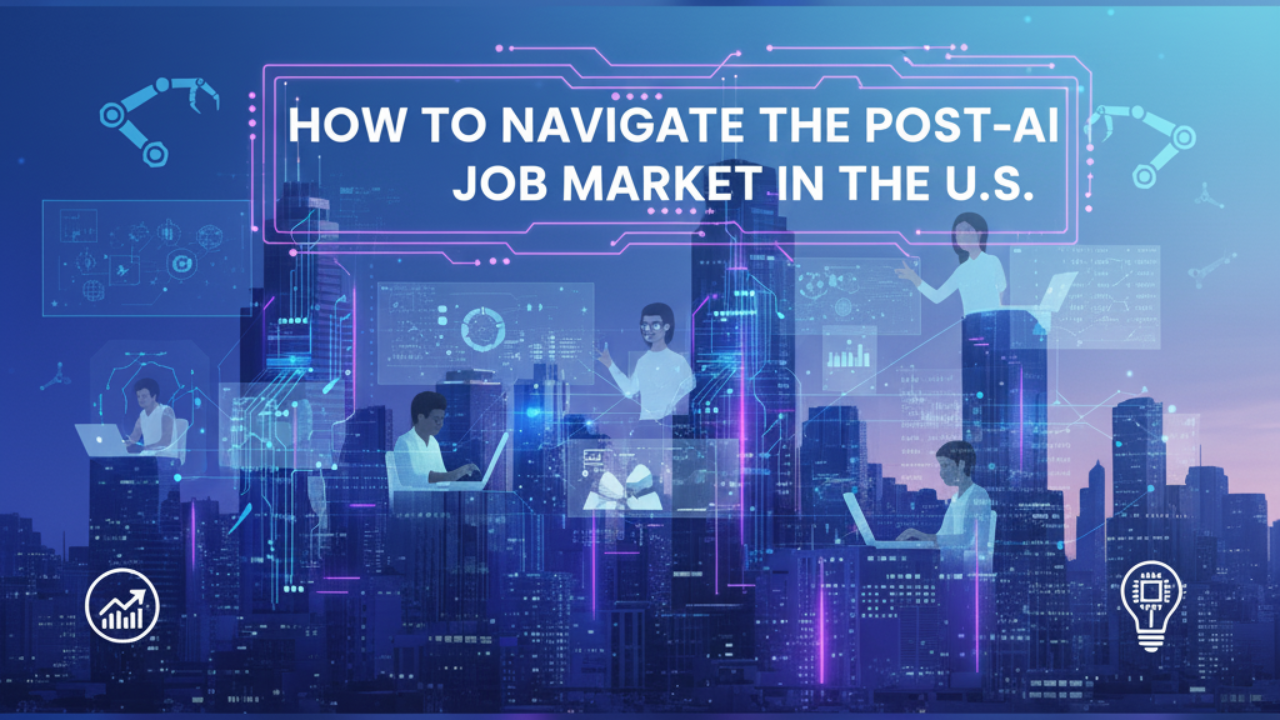
How to Navigate the Post-AI Job Market in the U.S. and Future-Proof Your Career
If you’ve been reading the headlines, it’s easy to feel a sense of dread about the future of work. “AI is coming for your job!” sounds more like a threat than a technological update. But here’s the truth they often miss: while AI will undoubtedly automate certain tasks, it is simultaneously creating a new post-AI job market.
In the U.S., this isn’t a distant future scenario; it’s happening now. From manufacturing floors in Ohio to marketing agencies in New York, artificial intelligence is reshaping roles, not just replacing them. The key to not just surviving but thriving in this new landscape is to understand the shift and adapt proactively.
This guide will walk you through exactly how to navigate the post-AI job market in the U.S., from the skills you need to the steps you can take today.

Section 1: The New American Job Landscape: Where AI is Hitting Hardest (and Creating the Most)
The impact of AI isn’t uniform. Some sectors are experiencing disruption, while others are booming.
Sectors Expercing Significant Shifts:
- Data-Intensive Roles: AI excels at analyzing vast datasets. This means roles in areas like data entry, basic analysis, and even some aspects of accounting and paralegal work are being augmented by AI tools, requiring fewer people for manual tasks.
- Repetitive Customer Service: Chatbots and AI-powered help centers are handling routine inquiries. However, this is creating a higher demand for human agents who can manage complex, empathetic, and escalated customer issues.
- Manufacturing & Logistics: Automation and AI-driven robots have been transforming assembly lines and warehouses for years, but they also create jobs in robot maintenance, programming, and system supervision.
Sectors with Explosive Growth:
- AI & Machine Learning Itself: The U.S. Bureau of Labor Statistics projects rapid growth for roles like Data Scientists, AI Specialists, and Machine Learning Engineers.
- Renewable Energy & Sustainability: As the U.S. pushes toward a greener economy, jobs in solar and wind energy installation, sustainability analysis, and environmental engineering are on the rise.
- Healthcare & Wellness: Roles like nurse practitioners, physical therapists, and home health aides are in high demand, particularly with an aging population. These roles rely heavily on a human touch that AI cannot replicate.
- Cybersecurity: As our world becomes more digital, the need to protect systems and data from cyber threats is more critical than ever.
Section 2: The Irreplaceable You: Skills That Matter in the Post-AI Era
So, what can you do that a machine can’t? The future belongs to “human skills.” While technical know-how is valuable, these are the competencies that will make you indispensable.
- Critical Thinking & Complex Problem-Solving: AI can provide data, but humans are needed to ask the right questions, interpret the results, and devise nuanced strategies.
- Creativity & Innovation: The ability to think outside the box, generate novel ideas, and approach problems from new angles is a uniquely human strength.
- Emotional Intelligence (EQ): Skills like empathy, collaboration, negotiation, and motivating a team are crucial for leadership and effective teamwork. A machine can’t sense office morale or comfort a distressed client.
- Adaptability & Lifelong Learning: The only constant is change. The willingness and ability to continuously learn and adapt to new tools and processes is the ultimate career insurance.
Section 3: Your Action Plan: Repositioning Your Career for the Future
Whether you’re a student, mid-career professional, or considering a switch, here’s how to pivot.
- For Students: Choose a major with a future. Fields like computer science, healthcare, and sustainable engineering are solid bets. But no matter your major, double-minor or take courses in “soft skills” like psychology, communication, or ethics.
- For Mid-Career Professionals: Conduct a “Skills Audit.” List your current skills and identify which are automatable and which are “human” skills. Then, focus on bridging the gap. An accountant might learn to use AI tools for data crunching to free up time for strategic financial advising. A marketer might shift from writing generic copy to developing high-level brand storytelling strategies.
- For Career Switchers: Look for adjacent opportunities. Your existing experience is not worthless. A customer service representative with high EQ could pivot into user experience (UX) research or HR. Use your foundational skills as a springboard into a new, more resilient field.
Section 4: Top U.S. Resources for Up-Skilling and Education (post-AI job market)
You don’t necessarily need a new 4-year degree. The U.S. is rich with accessible, high-quality up-skilling resources.
- Online Learning Platforms:
- Coursera & edX: Offer professional certificates from top U.S. universities like Stanford and MIT in high-demand fields like data science, project management, and IT support.
- LinkedIn Learning: Excellent for building specific software and business skills, with a direct link to showcasing them on your LinkedIn profile.
- Government & Non-Profit Initiatives:
- American Job Centers: Funded by the U.S. Department of Labor, these centers offer free career counseling, job search assistance, and information on training programs.
- COURSERA (Google Career Certificates): Google offers professional certificates in high-growth fields like IT Support, UX Design, and Project Management, designed to be completed in about 6 months.
- Traditional Education (The Flexible Route): Many U.S. universities now offer part-time, online master’s degrees and boot camps in tech-focused fields, allowing you to learn while you work.
Section 5: The Future Outlook: Staying Resilient in a Changing World
The post-AI job market won’t be a one-time shift; it will be a continuous evolution. To stay resilient:
- Cultivate a “Hybrid” Mindset: Think of yourself as a “human-AI collaboration.” Your value will increasingly come from your ability to work with AI, using it as a tool to enhance your human capabilities.
- Build Your Professional Network: In a dynamic market, opportunities often come through connections. Stay active on LinkedIn, attend industry webinars, and nurture your professional relationships.
- Stay Informed, Not Alarmed: Follow reputable tech news sources and thought leaders to understand emerging trends without getting swept up in the hype and fear.
Conclusion: Your Future is in Your Hands (post-AI job market)
The rise of AI is not the end of human work; it’s a recalibration. By focusing on the skills that make us uniquely human—our creativity, empathy, and strategic thinking—and by committing to lifelong learning, you can not only navigate the post-AI job market in the U.S. but excel in it.
The time to act is now.
What’s the first step you’ll take to future-proof your career? Share your plan in the comments below or sign up for our newsletter for more insights and resources delivered to your inbox!